
AI SEO Tutorial: Optimizing for AI and Gen-Next Search
AI SEO Tutorial: How to Optimize Websites for ChatGPT, Google AI Overviews and Next-Generation Search
When Google first released its official guide on AI search optimization, it reiterated the importance of on-site SEO along with setting down proper guidelines. For marketers and business owners as well as digital marketing service providers, this became their SEO Bible. They went from floundering to integrate best practices listed on any website offering an AI SEO tutorial to having an authoritative explanation of how to optimize for AI search. This was quite an achievement.
This guide offered deep insights into which strategies to adopt and which actions to implement to achieve the ultimate goal: mention in AI overviews and Google snippets.
Here, in this blog, we will attempt to recreate the guide with a focus on AI-driven SEO strategies that will help overcome the foundational disruption caused by the advent of AI.
Some myth-busting generative AI visibility optimization strategies
Any new technology always comes with three things: theories, practices, and misconceptions. Let’s address the myths before we start with our Generative AI SEO tutorial.
| Myth | Busted |
| You need new machine-readable files like LLMS.text and other special markups or Markdown to appear in Google. | Google neither has any use for them nor are they treated in any special way. |
| Breaking your content into tiny chunks to make it easy for AI to understand them. | Make pages that add value to your audience. However, AI understands the essence of your content better if a direct answer immediately follows the question. |
| Rewriting specifically for AI systems | No need, as AI systems can connect queries to answers by understanding its synonyms and general meanings. |
| Overfocusing on structured data | Not required for Generative AI searches. But it is a good practice to adopt as part of your overall SEO strategy. |
With the myths busted, it is time to focus on how to ensure AI crawlers become your website’s best friend.
Why is AI search optimization the key focus area?
The answer can best be defined as the result of the click collapse. Back in the year 2024, a Gartner study rightly predicted that by the year 2026, AI chatbots and other virtual agents will cause a drop of 25% in search engine volumes.
We are seeing it happen today. And it is not a seasonal or cyclical downturn. It is a permanent behavioral substitution driven by Gen AI platforms like:
- Google’s AI Overviews and Gemini
- Standalone answer engines like ChatGPT, Perplexity, and others
This has resulted in the collapse of the click-through rate (CTR), reducing clicks from a primary KPI to a collapsed one. This transition is primarily driven by:
- User substitution: Change in user preferences from traditional search engines to AI-native platforms, resulting in zero possibility of users clicking your link.
- Click cannibalization: Users who are still opting for traditional search engines are being intercepted by AI-generated summaries like Google’s AI Overview. Giving them the answers directly on the SERP further minimizes chances of clicking on websites.
This change in user behavior has broken the foundational search marketing business model. The need is to opt for a brand-marketing model with AI answer inclusion rate and share of influence as your major KPIs for measuring ROI.
What your AI optimization guide should include
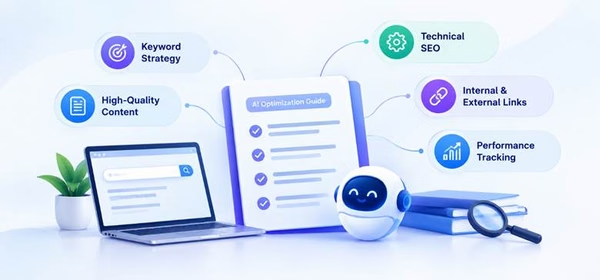
To optimize websites for AI search, you must first understand the difference between SEO and AI SEO. This difference will help you improve your optimization strategies and align them with AI crawlers. Traditional SEO deals with optimizing your website to increase its visibility on search engines. AI SEO optimizes your website content for AI-native platforms and search engines.
Do you need both? Yes, because it ensures greater reach. Also, most search engine interfaces like Google and Bing offer a mix of traditional organic results and AI Overviews and AI-powered summaries.
Let’s look at the key elements you must integrate to improve your AI optimization efficiency and Google AI visibility.
Creating valuable long-form content
AI prefers content that is detailed, topic-rich, and answers user queries directly. To meet these user expectations, you must:
- Write comprehensive long-form content that gives a unique insight into the topic
- Break down complex topics and headings into manageable sections
- Your content must cover many different aspects of the topic so it satisfies a wide range of user queries
Expert insights and authoritative content
AI algorithms are trained to prioritize content that demonstrates EEAT (Expertise, Experience, Authority, and Trustworthiness). Stand out so you are spotted by AIs by incorporating:
- Expert quotes, analysis, and opinions
- Actionable tips that users can replicate and implement
- Data and research from credible sources
Technical crawlability optimization
A technically well-optimized website improves your content discoverability and makes it more usable by AI systems. More importantly, it also improves the user experience, a key ranking metric for Google. To ensure this, you must focus on:
- Implementing structured data to help search engines understand the context of your content and improve chances of gaining visibility in AI overviews and summaries
- For AI search optimization, meta titles and descriptions need to be clear and keyword-rich
- Improve responsiveness by integrating mobile optimization best practices and meet the Core Web Vitals set by Google for load speed, visual stability, and interactivity
Topic clustering and linking
Accurately define content hierarchies and relationships because AI crawlers excel at interpreting them. To make for AI-ready websites, you must:
- Develop precise content hubs by grouping related articles into topic clusters around a central “pillar” with interlinking within relevant articles
- Leverage interlinking to help guide users and AIOs in their journeys throughout your website to reinforce the relevance and authority of your website
With Bing Search algorithms differing from other search engines, its AI-driven SEO strategies must also differ. Bing’s major difference with Google arises from keyword usage and content presentation, requiring websites to integrate relevant strategies to improve visibility in Bing AI summaries. To tailor for Bing AI, include the following in your AI SEO.
Keyword Density and Strategic Placement
Bing prefers keyword-rich content. But that does not mean you will indulge in keyword stuffing. Intentional strategic placement of primary, secondary, and long-tail keywords helps content rank better in Bing. Two practices that you must follow for Bing AI summaries:
- Include primary keywords in headings, metadata, and body content
- Repeat key phrases naturally within the content
Direct and Concise Answers
Like Google, Bing also prefers content that delivers immediate value. So, ensure your content is scannable and digestible. Further, leverage the following strategies:
- Use FAQ sections to address common user queries
- Incorporate bulleted lists and highlight key points for quick takeaways
Prioritize Search Intent Over Storytelling

Bing’s algorithms prioritize content that addresses user search intent. Craft straightforward content that delivers relevant and precise information. Keep the following in mind:
- Use headings and subheadings
- Avoid lengthy introductions
- Dive straight into the subject matter
User behavior is diversifying, making it mandatory for an AI SEO strategy to comprehensively include factors that go beyond platform-specific optimization. To meet user needs and intents, businesses must create value-driven, intent-aligned content.
Conclusion: Future-proofing your AI SEO
Traditional SEO techniques are no longer enough. Businesses must optimize content for long-tailed queries, authoritative insights, and structured content to address the unpredictability of AI-powered search and its evolution. This also allows them to remain AI-ready websites that are discoverable, relevant, and competitive for years to come.
FAQs
What is AI SEO and how is it different from traditional SEO?
AI SEO comes into play when you optimize content for visibility across AI tools like ChatGPT, Gemini, Perplexity, and Google AI Overviews. Traditional SEO tries to rank pages on search engines for clicks.
Does traditional SEO still matter in the era of AI Overviews and ChatGPT search?
Yes. AI tools draw content from different search engine data. Websites and pages that rank well and get crawled often are prioritized. So it is important that you improve the technical health of your website, ensure you provide quality backlinks, improve keyword relevance, and integrate helpful content to help your website get indexed. Thus, traditional SEO is the foundation that AI visibility is built on.
How does website development impact AI SEO performance?
AI crawlers prioritize websites and pages that are fast, clean, and accessible. Leveraging clean HTML structure, schema markup, logical internal linking, good mobile performance and crawler-friendly robots.txt settings are all part of AI SEO website development. This allows AI systems to read your content and cite it accurately.
How can businesses measure success in AI SEO when rankings are no longer the only metric?
You can track AI SEO success by measuring how often AI answers mention or cite your brand. You must also compare your data with that of your competitors and monitor referral traffic from different AI platforms like ChatGPT and Perplexity.
How can businesses optimize their websites for ChatGPT and AI-powered search engines?
Answer real customer questions directly in the opening lines of each page. Use clear headings, FAQs, and schema markup, and allow AI crawlers such as GPTBot and OAI-SearchBot. Build authority through reviews, PR mentions, and listings on trusted sites. Keep content fresh, factual, and consistent everywhere it appears.






About Author

Samrat
Samrat Biswas is a distinguished VP of Operations, Engineering, and Growth at Unified Infotech, renowned for his deep expertise in scaling teams and refining processes. Samrat’s writings are informed by his wealth of experience, offering readers valuable insights into the intricacies of engineering leadership, operational efficiency, and driving transformational change within organizations. Connect with his on Linkedin