
Meta Ads for eCommerce: Strategies to Turn Traffic Into Sales

The easy part is getting people to click your ad. The real money is lost when you’re trying to get them to buy. Look at Meta ads for eCommerce: you can invest a lot of money in Facebook and Instagram and see your traffic rise, only to think at the end of the month, “Why aren’t the sales coming?”
This is because the money you make is between a click and a customer. Most of the fixes aren’t purely technical; they involve how your ads, product pages, tracking, and checkout work together. Let’s look at Meta ads data for eCommerce and find out what really gets customers to hit the checkout button.
What is considered Good Meta Ads for eCommerce Performance?
You have to obtain a realistic yardstick before making any changes. Many online sources talk about a 4x return being the norm, and it makes many store owners feel like they are failing.
In reality, it is not that high. Triple Whale analyzed approximately 35,000 ad accounts in 2025 and found a median ROAS (return on ad spend) of 1.86x. The median CPM was $14.19, while the click-through rate was 2.19% and the conversion rate was around 1.6%. The average cost to acquire one purchase was $38.19, while the average order value was $71.69.
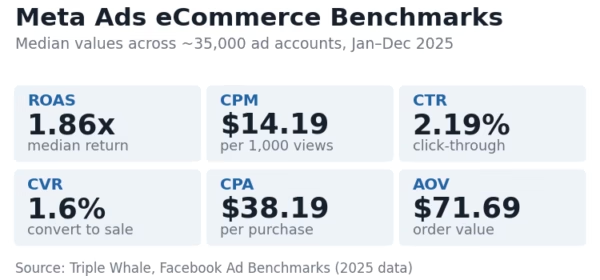
[Source: Triple Whale, 2025 data] Median Meta ads performance for eCommerce]
Costs are also increasing. That CPM was more than 20% higher than last year, which means your same budget is going to get you fewer impressions than it did last year. There is some relief for retail brands, however. According to WordStream’s 2025 benchmark study of 1,180 campaigns, the shopping and gifts category boasts the highest CTR of any vertical at 4.13% and the lowest cost per click at $0.34.
Work Out Your Own Break-Even Number
Platform media is not a target. The ROAS that counts is the one that covers your costs. Divide 1 by your contribution margin.
If you’re making 40 cents per dollar after product and shipping costs, you are at 2.5x break-even. You must achieve a 4.0x to maintain your position at a 25% margin. 2.2x returns are great for one store, and slow returns are great for another.
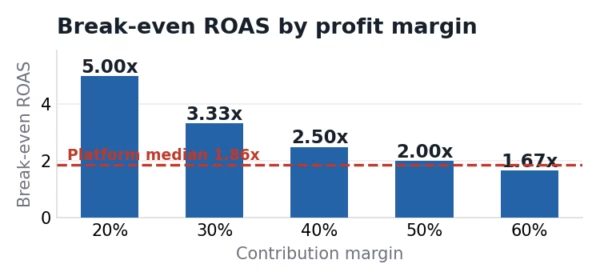
[Thinner margins demand a higher return. The dashed line is the platform median.]
See More: What is Meta Pixel, and How to Add it to your website?
First Things First – Fix Your Tracking
All of the following strategies rely on Meta determining who converted from clicks to sales. With Apple tracking changes from 2021, browser tracking alone is missing a significant portion of conversions, and if the algorithm doesn’t see your sales, it can’t find more buyers.
Two things need to be in place. The Meta pixel on your site and the Conversions API (CAPI), which sends purchase data to Meta from your server instead of the visitor’s browser. Most Shopify or WooCommerce stores can enable CAPI via an official integration without any coding.
Retailers typically find that they can recover 20%-30% of lost conversion signals with both running concurrently, depending on the store. Either way, the more conversion data you can accurately capture, the more useful signals Meta has for optimizing campaigns toward likely buyers
But one caution. When attributed conversions surge following a tracking fix, it doesn’t mean that you are suddenly attracting more customers; it simply means you’re measuring more of them. Check MER (total revenues/total ad spend) from your own backend, as this will not be affected by attribution settings.
Content is the New Targeting
Meta has been working for the past few years to shift audience selection to its own systems. The company announced the results of the rebuilt ads retrieval engine called Andromeda in December 2024, which saw a 6% increase in recall and an 8% boost in ads quality on selected segments.
The result is simple. Now your ads are the targeting layer as the algorithm reads your creative to determine who it’s shown to. More importantly than narrowing your audience is providing Meta with diverse assets to test.
What to Put in Your Creative Rotation
- Problem First Hooks: Start with the problem your product solves rather than the brand name.
- Custom footage: Phone-shot clips that read like recommendations rather than ads.
- Static images: Cost-effective and easy to produce in large numbers, making them useful for testing different creative angles alongside video.
- Social proof: A review screenshot, with a plain background, can be more effective than a pretty studio photo.
- Offer-led ad: Offer a discount on bundles, free shipping after a certain amount, or offer a discount for a first order.
Watch for fatigue rather than guessing. If frequency starts to increase beyond 2.5-3.0 times per week and the reach starts to decrease by 15%-20% while CPM rises, it’s time to retire the creative. Most stores update the content every 2-4 weeks.
Are Shopping Campaigns with Advantage+ Right for You?
One of the campaign types that Meta offers is Advantage+. It is an automated campaign type that utilizes minimal input from you for audience, placement, and budget. In January 2025, Meta CFO Susan Li told investors that these campaigns reached a $20 billion annual run rate, which is 70% higher than the previous year.
Performance-wise, the number Meta has released is based on research from 15 A/B tests that showed that these campaigns resulted in a 12% reduction in cost per purchase as compared to advertisers’ default configuration. That’s just a few of Meta’s own tests. There are more substantial claims on the internet (30% or more), but these are from agency case studies, not published research.
Try before you commit. Run your manual campaigns concurrently with Advantage+ for 2-3 weeks and compare cost per purchase. Automation is best for stores that have regular conversion volume and have ample creativity. If you start with only three ads and a few sales per week, there may not be enough conversion data for the system to learn effectively.
The Best Places to Find Sales
Most of your traffic bounces without a purchase and it’s normal. According to Baymard Institute, which has gathered 50 different studies on the topic, the average cart abandonment rate online is 70.22%. 7 out of 10 people who add to cart don’t really order.
The cost of these shoppers is much lower than the cost of a stranger. Instead of one single retargeting campaign, divide them according to their level of proximity:
- Cart abandoners 1-3 days: display the specific product they abandoned and address the issue that prevents them from completing a purchase.
- Product viewers 4-14 days: focus on reviews, as these shoppers are still comparing options.
- Current customers: advertise the complementary product, not the product they already have.
Baymard also notes that the top reason for abandonment is additional fees that crop up at checkout. Don’t promote these shoppers without revealing shipping costs first. Don’t look for retargeting solutions when people are surprised at checkout.
Retargeting claims to work, since some of those buyers will be coming back anyway. But to keep the split sensible, most stores invest 70% to 80% of their budget into acquiring new customers. Warm audiences are small and beating them increases frequency.
Your Product Page is 50% of the Campaign
Even when your ads generate clicks, only a portion of that paid traffic will convert into customers. That makes the product page an important part of the campaign, and improving the page can often be more efficient than simply buying more traffic. This is why it is worth looking at the broader eCommerce experience when diagnosing conversion problems.
- Match the ad to the page: If it has a particular color or offer in the ad, then that should be matched. Also, paid clicks that go to your homepage are a total waste.
- Shorten the load time: This is especially important for traffic from phones, where people don’t have a lot of patience. The eCommerce benchmark reports that 50% of customers abandon their shopping carts when checkout takes more than 30 seconds.
- Do not have hidden fees: Hidden fees are the number one reason for abandonment.
- Place reviews close to the buy button, NOT at the bottom of the page.
- Trim the checkout: Provide guest checkout and eliminate any fields that are not necessary.
Test in a Way That Yields You an Answer
There is a lot of money wasted on restless tinkering. If you make three changes to the audience, creative and budget in the same week, how will you know what worked? Try to change 1 thing at a time, wait for a minimum of 3-7 days to evaluate a new campaign, and aim for about 50 conversions before drawing a firm conclusion. Evaluate based on cost per sale, NOT cost per click.
Frequently Asked Questions
1. What is a good ROAS(return on ad spend) for eCommerce Meta ads?
In 2025, the median of approximately 35,000 accounts was 1.86x. Well, it depends on your margin. To calculate break-even, divide 1 by the contribution margin; then try to exceed the break-even.
2. What will the initial cost be?
Dedicated funds that allow the system to collect the information and a daily budget that results in one or two purchases per day instead of a week. Very small budgets often have too little data to learn from, as the cost per purchase is near the median of $38.
3. Why do my ads perform well for a while and then suddenly fail?
Usually creative fatigue. The click-through rate decreases, and costs increase after an ad has been viewed by the same people three or more times within a week. Update the creative; don’t increase the budget.
4. Do I really require the Conversions API if I already own the Pixel?
Yes, in most cases. Browser tracking alone is no longer able to capture conversions since Apple’s privacy changes. Both feeds add more complete information to Meta, which will enhance targeting and reporting.
5. Which option should I choose: Advantage+ or creating campaigns myself?
Test both. Automation is a good option for stores that have a consistent amount of conversions and have a lot of creativity. For newer shops with low data volumes, manual control might be a better strategy in the beginning until sales stabilize.
Conclusion
There aren’t any secret targeting tips that convert shoppers into customers. It is all about having clean data that flows back to Meta, creative that’s diverse enough to be valuable to the algorithm, a product page that doesn’t frustrate viewers till the final step, and honest maths regarding what a profitable return might look like for your margins.
Identify the weakest element of that chain and correct it this week. For most stores, it’s the tracking setup or checkout, and both are one-off tasks that continue to pay off well beyond the life of the campaigns.
About Author

Micky Joseph
Micky is a passionate blogger, who writes enriching posts on web design, web development and technology news. He loves writing about web development, tips, tools, tutorials, cloud, hosting, domain, and also sharing knowledge about latest technology news. He also writes about cms, programming language and various software. Follow us on FlipBoard.